
What is Dialectical Behavior Therapy?
DBT is a cognitive-behavioral treatment originally designed to treat suicidal behaviors. Today, DBT is the gold standard treatment for borderline personality disorder. Research now shows that DBT is effective in addressing a multitude of complex conditions, including post-traumatic stress disorder, substance use, depression, bipolar disorder, and eating disorders.
The DBT Approach
Biosocial Theory: Where do problems originate?
DBT begins with the understanding that emotional and behavioral difficulties develop through the ongoing interaction between our biology and our environment. Some people experience emotions more quickly, intensely, and for longer periods of time. When that emotional sensitivity develops within environments that struggle to understand, validate, or effectively respond to those experiences, regulating emotions can become increasingly difficult. Behaviors that may look problematic from the outside often develop as understandable attempts to cope, regulate emotion, or reduce distress.
Dialectics: How do we understand those problems?
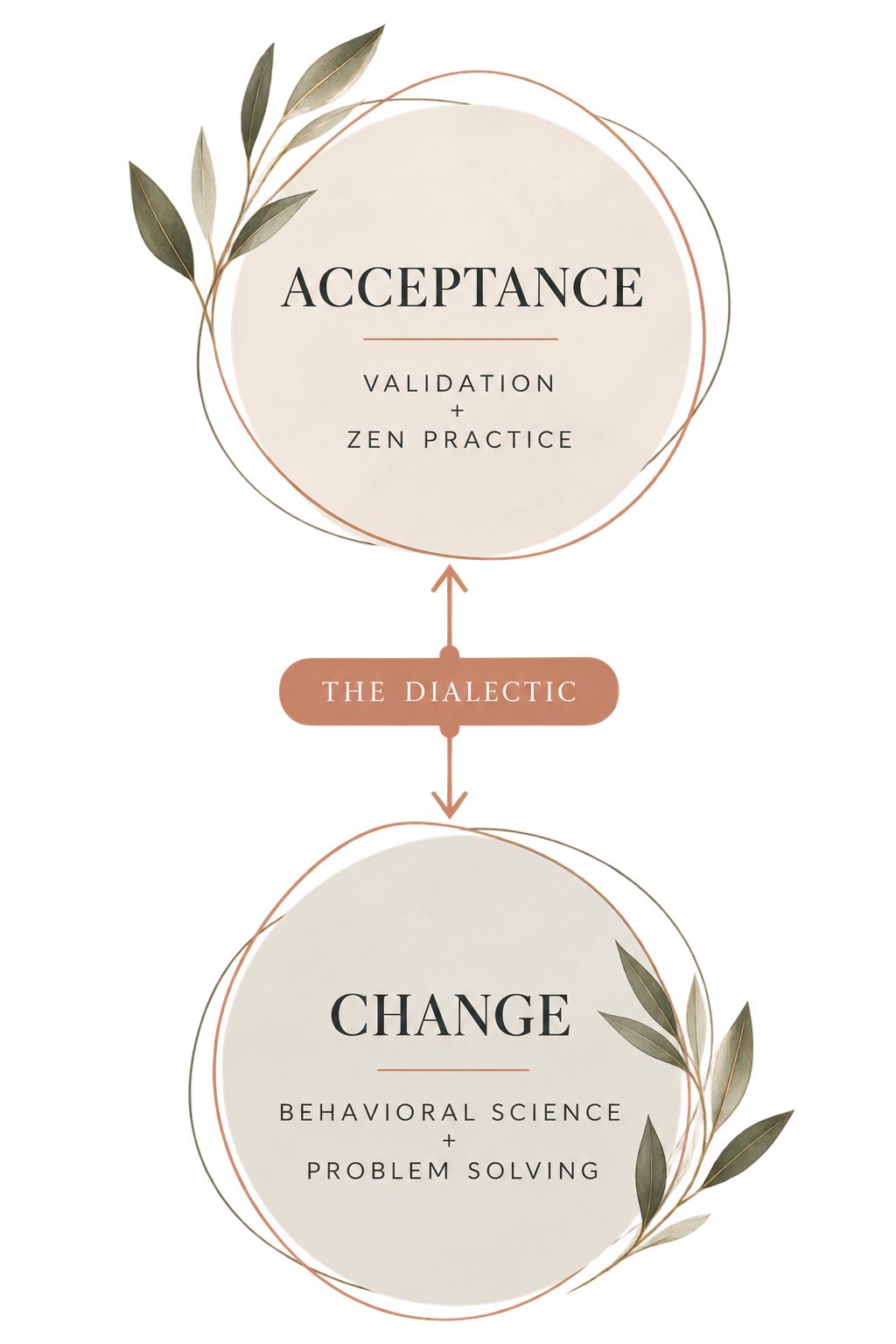
Dialectics is the idea that two seemingly opposing things can both be true at once. In DBT, the central dialectic is acceptance and change: we work to understand and accept ourselves and our circumstances as they are, while also recognizing what needs to change and working to meaningfully create change. Rather than feeling torn between absolute, black-and-white thinking, dialectics holds multiple truths at once and works to find synthesis in effort to reduce suffering and increase psychological flexibility.
Behavioral Science: How do we create change?
DBT is a third-wave behavioral treatment. This means DBT treats thoughts, emotions, actions, physical sensations, and physiological responses as behaviors. A multitude of strategies are employed to increase and decrease specific behaviors, including problem solving, contingency management, exposure, skill building, and dialectical thinking.
Zen: How do we practice acceptance?
While DBT was developed from behavioral science, it is also rooted in principles of Zen. From this lens, DBT acknowledges that all circumstances are caused, that change is the only constant, and that a deep, nonjudgmental acceptance of reality as reality is effectively reduces suffering and increases joy and living with present awareness.

Skillful Means
-
Develop awareness to a deep sense of inner wisdom that allows you to stay present while increasing joy and reducing suffering.
-
Gain a sense of safety and control in the face of overwhelming stress. When faced with crisis situations, learn ways to detach from impulsive or destructive behaviors.
Come to acknowledge reality as it is by allowing what is present to be here. Let go of outcomes and control by accepting and tolerating the current circumstances of life.
-
Come to understand why emotions exist, what they do for us, and how to regulate them. Increase emotions you want to experience more and decrease emotions you want to experience less.
Become able to sit with painful emotions without reacting in ways that lead you away from your ultimate goals. Become fluent in your emotional landscape by experiencing emotions as they arise and as they all, without having to change what is.
-
Navigate relationships with your friends, family, significant other, and acquaintances more skillfully.
Feel confident setting limits, asking for what you want, and being taken seriously. Learn to build, repair, and end relationships while maintaining your self-respect.
-
Become your own behaviorist by learning how to set contingencies, reinforce yourself and others, and provide validation or recover from invalidation.
Recognize areas you may experience imbalance and integrate dialectics in ways that help you recover from impulsive, absolute, or rigid approaches to life.
Doing
DBT
DBT is an intensive approach to therapy. Treatment lasts for one year and includes weekly participation in individual therapy and skills group. Clients are asked to commit to reducing and eliminating unskillful behaviors that interfere with long-term goals and to increase behaviors that are congruent with building a life worth living. This requires regular data tracking, completion of homework outside of sessions, and a willingness to agree to the assumptions and philosophy of DBT.